Abstract
Field evidence for a probable emerging beaver territory
The Eurasian beaver (Castor fiber) was extirpated from Switzerland by the beginning of the nineteenth century and later re-established through coordinated reintroductions between 1956 and 1977. The species has since expanded through major river systems and increasingly into smaller tributaries. This field report documents recent evidence from the Ergolz River near Liestal, Canton of Basel-Landschaft, where repeated signs of beaver activity have been recorded since December 2025.
Field indicators include tree felling and girdling, feeding remains, bank slides and access points, partial dam-building or woody accumulation, and sustained nocturnal activity documented by camera traps. A particularly important observation occurred on 16 February 2026, when two adult beavers were recorded simultaneously within the same river segment.
Taken together, the continuity of field signs and paired adult presence suggest a likely transition from transient dispersal to territorial occupation. However, reproduction has not yet been confirmed. The Liestal observations are discussed in the broader context of beaver recovery in Switzerland, tributary recolonisation, ecosystem engineering, hydrological resilience, biodiversity enhancement, carbon storage, and local human-wildlife coexistence.
Keywords: Eurasian beaver; Castor fiber; Switzerland; Ergolz; Liestal; recolonisation; territorial establishment; ecosystem engineering; wetland restoration; biodiversity; human-wildlife coexistence.
Résumé
Indices de terrain pour un probable territoire émergent de castor
Le castor d’Europe (Castor fiber) avait disparu de Suisse au début du XIXe siècle avant d’être réintroduit de manière coordonnée entre 1956 et 1977. Depuis, l’espèce s’est développée le long des grands systèmes fluviaux et progresse de plus en plus dans des affluents plus petits. Ce rapport documente des indices récents observés sur l’Ergolz près de Liestal, dans le canton de Bâle-Campagne, où des signes répétés d’activité du castor ont été relevés depuis décembre 2025.
Les indicateurs comprennent l’abattage et l’annelage d’arbres, des restes alimentaires, des coulées et points d’accès aux berges, des éléments partiels de construction de barrage ou d’accumulation de bois, ainsi qu’une activité nocturne continue documentée par pièges photographiques. Une observation importante a eu lieu le 16 février 2026, lorsque deux castors adultes ont été enregistrés simultanément dans le même tronçon de rivière.
Pris ensemble, la continuité des indices et la présence simultanée de deux adultes suggèrent une transition probable entre une dispersion temporaire et une occupation territoriale. La reproduction n’a toutefois pas encore été confirmée. Les observations de Liestal sont discutées dans le contexte du retour du castor en Suisse, de la recolonisation des affluents, de l’ingénierie écosystémique, de la résilience hydrologique, du renforcement de la biodiversité, du stockage du carbone et de la coexistence locale.
Mots-clés : castor d’Europe ; Castor fiber ; Suisse ; Ergolz ; Liestal ; recolonisation ; installation territoriale ; ingénierie écosystémique ; restauration des zones humides ; biodiversité ; coexistence humain-faune sauvage.
Zusammenfassung
Feldhinweise auf ein wahrscheinlich entstehendes Biberrevier
Der Europäische Biber (Castor fiber) war zu Beginn des 19. Jahrhunderts in der Schweiz ausgerottet und wurde zwischen 1956 und 1977 durch koordinierte Wiederansiedlungen erneut etabliert. Seither hat sich die Art entlang grosser Flusssysteme und zunehmend auch in kleinere Zuflüsse ausgebreitet. Dieser Bericht dokumentiert aktuelle Hinweise von der Ergolz bei Liestal im Kanton Basel-Landschaft, wo seit Dezember 2025 wiederholt Spuren von Biberaktivität festgestellt wurden.
Zu den Feldindikatoren gehören Baumfällungen und Ringelungen, Fraßreste, Rutschen und Uferzugänge, teilweise Dammbau- oder Holzansammlungen sowie anhaltende nächtliche Aktivität, die durch Fotofallen dokumentiert wurde. Eine besonders wichtige Beobachtung erfolgte am 16. Februar 2026, als zwei erwachsene Biber gleichzeitig im selben Flussabschnitt erfasst wurden.
Zusammengenommen deuten die Kontinuität der Feldspuren und die gleichzeitige Anwesenheit zweier adulter Tiere auf einen wahrscheinlichen Übergang von vorübergehender Dispersion zu territorialer Nutzung hin. Fortpflanzung wurde jedoch bisher nicht bestätigt. Die Beobachtungen werden im Kontext der Bibererholung in der Schweiz, der Wiederbesiedlung von Zuflüssen, der Ökosystemgestaltung, der hydrologischen Resilienz, der Biodiversität, der Kohlenstoffspeicherung und der lokalen Koexistenz diskutiert.
Schlüsselwörter: Europäischer Biber; Castor fiber; Schweiz; Ergolz; Liestal; Wiederbesiedlung; territoriale Etablierung; Ökosystemingenieur; Feuchtgebietsrestaurierung; Biodiversität; Mensch-Wildtier-Koexistenz.
Riassunto
Evidenze di campo per un probabile territorio emergente del castoro
Il castoro europeo (Castor fiber) era scomparso dalla Svizzera all’inizio del XIX secolo ed è stato successivamente ristabilito attraverso reintroduzioni coordinate tra il 1956 e il 1977. Da allora la specie si è espansa lungo i principali sistemi fluviali e sempre più anche nei tributari minori. Questo rapporto documenta evidenze recenti dal fiume Ergolz presso Liestal, nel Cantone di Basilea Campagna, dove dal dicembre 2025 sono stati registrati segni ripetuti di attività del castoro.
Gli indicatori di campo includono abbattimento e scortecciamento ad anello di alberi, resti di alimentazione, scivoli e punti di accesso alle sponde, parziale costruzione di dighe o accumuli di legno e attività notturna continuativa documentata da fototrappole. Un’osservazione particolarmente importante è avvenuta il 16 febbraio 2026, quando due castori adulti sono stati registrati simultaneamente nello stesso tratto di fiume.
Nel loro insieme, la continuità dei segni di campo e la presenza simultanea di due adulti suggeriscono una probabile transizione da una dispersione transitoria a un’occupazione territoriale. La riproduzione, tuttavia, non è ancora stata confermata. Le osservazioni sono discusse nel quadro del recupero del castoro in Svizzera, della ricolonizzazione dei tributari, dell’ingegneria ecosistemica, della resilienza idrologica, della biodiversità, dello stoccaggio del carbonio e della coesistenza locale.
Parole chiave: castoro europeo; Castor fiber; Svizzera; Ergolz; Liestal; ricolonizzazione; stabilizzazione territoriale; ingegneria ecosistemica; ripristino delle zone umide; biodiversità; coesistenza uomo-fauna selvatica.
1. Introduction
Beavers as ecosystem engineers in recovering river systems
The Eurasian beaver (Castor fiber) is one of the most influential semi-aquatic mammals in European river systems. Through dam-building, tree felling, canal digging, pond creation, and bank modification, beavers restructure river corridors and reintroduce ecological processes that have often been weakened or lost in channelised and intensively managed landscapes (Brazier et al., 2021; Larsen et al., 2021).
In Switzerland, C. fiber was extirpated by the beginning of the nineteenth century, primarily because of overhunting for fur, meat, and castoreum. Between 1956 and 1977, 141 beavers from French, Norwegian, and Russian source populations were released at 30 sites in 44 release events, creating the basis of the current national recovery (Minnig et al., 2016).
The 2022 national beaver census documented 1,382 territories in Switzerland and 20 additional territories in Liechtenstein, corresponding to approximately 4,900 individuals across both countries. This represents a strong increase since the 2008 census and indicates that the species is expanding not only along major rivers but also into smaller and structurally constrained tributaries (Angst et al., 2023).
Secondary tributaries are especially important for understanding the next phase of beaver recovery. They may provide dispersal corridors, breeding territories, and ecological restoration opportunities, but they are also where conflicts with bank maintenance, agriculture, paths, dogs, and infrastructure are most likely to occur. The Ergolz River, a tributary of the Rhine in Basel-Landschaft, represents such a landscape: modified in places, locally semi-natural, and ecologically promising but vulnerable.
This article formalises recent field observations from the Liestal section of the Ergolz into a cautious scientific field report. The central question is whether the available signs are better interpreted as isolated dispersal events or as the beginning of a more stable territorial occupation.
1. Introduction
Le castor comme ingénieur des écosystèmes fluviaux en reconquête
Le castor d’Europe (Castor fiber) est l’un des mammifères semi-aquatiques les plus influents des systèmes fluviaux européens. Par la construction de barrages, l’abattage d’arbres, le creusement de canaux, la création d’étangs et la modification des berges, les castors restructurent les corridors riverains et réintroduisent des processus écologiques souvent affaiblis ou perdus dans les paysages canalisés et intensivement gérés (Brazier et al., 2021 ; Larsen et al., 2021).
En Suisse, C. fiber avait disparu au début du XIXe siècle, principalement en raison de la chasse excessive pour la fourrure, la viande et le castoréum. Entre 1956 et 1977, 141 castors issus de populations françaises, norvégiennes et russes ont été relâchés sur 30 sites lors de 44 opérations, constituant la base du rétablissement actuel de l’espèce (Minnig et al., 2016).
Le recensement national de 2022 a documenté 1 382 territoires en Suisse et 20 territoires supplémentaires au Liechtenstein, correspondant à environ 4 900 individus dans les deux pays. Cette progression importante montre que l’espèce ne s’étend plus seulement le long des grands cours d’eau, mais aussi dans des affluents plus petits et structurellement contraints (Angst et al., 2023).
Les affluents secondaires sont importants pour comprendre la prochaine phase du retour du castor. Ils peuvent offrir des corridors de dispersion, des territoires de reproduction et des possibilités de restauration écologique, mais ce sont aussi des secteurs où les conflits avec l’entretien des berges, l’agriculture, les chemins, les chiens et les infrastructures sont probables. L’Ergolz, affluent du Rhin en Bâle-Campagne, représente un tel paysage : modifié par endroits, localement semi-naturel, écologiquement prometteur mais vulnérable.
Cet article formalise les observations récentes réalisées sur le tronçon de l’Ergolz à Liestal sous la forme d’un rapport scientifique prudent. La question centrale est de savoir si les indices disponibles doivent plutôt être interprétés comme des événements isolés de dispersion ou comme le début d’une occupation territoriale plus stable.
1. Einleitung
Biber als Ökosystemingenieure in sich erholenden Flusssystemen
Der Europäische Biber (Castor fiber) zählt zu den einflussreichsten semiaquatischen Säugetieren europäischer Flusssysteme. Durch Dammbau, Baumfällungen, Kanalgraben, Teichbildung und Uferveränderungen strukturieren Biber Flusskorridore neu und bringen ökologische Prozesse zurück, die in kanalisierten und intensiv bewirtschafteten Landschaften oft geschwächt wurden oder verloren gingen (Brazier et al., 2021; Larsen et al., 2021).
In der Schweiz wurde C. fiber zu Beginn des 19. Jahrhunderts ausgerottet, hauptsächlich durch Überbejagung wegen Pelz, Fleisch und Bibergeil. Zwischen 1956 und 1977 wurden 141 Biber aus französischen, norwegischen und russischen Herkunftspopulationen an 30 Standorten in 44 Freilassungen ausgesetzt und damit die Grundlage der heutigen nationalen Erholung geschaffen (Minnig et al., 2016).
Die nationale Bibererhebung 2022 dokumentierte 1’382 Reviere in der Schweiz und 20 weitere in Liechtenstein, was ungefähr 4’900 Individuen in beiden Ländern entspricht. Dies stellt seit der Erhebung von 2008 einen starken Anstieg dar und zeigt, dass sich die Art nicht nur entlang grosser Flüsse, sondern zunehmend auch in kleinere und strukturell eingeschränkte Zuflüsse ausbreitet (Angst et al., 2023).
Sekundäre Zuflüsse sind besonders wichtig, um die nächste Phase der Bibererholung zu verstehen. Sie können Ausbreitungskorridore, Fortpflanzungsreviere und Chancen für ökologische Restaurierung bieten, sind aber auch jene Räume, in denen Konflikte mit Uferunterhalt, Landwirtschaft, Wegen, Hunden und Infrastruktur am wahrscheinlichsten auftreten. Die Ergolz, ein Zufluss des Rheins in Basel-Landschaft, steht für eine solche Landschaft.
Dieser Artikel fasst aktuelle Feldbeobachtungen aus dem Liestaler Abschnitt der Ergolz in einem vorsichtigen wissenschaftlichen Feldbericht zusammen. Die zentrale Frage lautet, ob die verfügbaren Zeichen eher als isolierte Dispersionsereignisse oder als Beginn einer stabileren territorialen Besetzung zu deuten sind.
1. Introduzione
Il castoro come ingegnere ecosistemico nei sistemi fluviali in recupero
Il castoro europeo (Castor fiber) è uno dei mammiferi semiacquatici più influenti dei sistemi fluviali europei. Attraverso la costruzione di dighe, l’abbattimento di alberi, lo scavo di canali, la creazione di stagni e la modifica delle sponde, i castori ristrutturano i corridoi fluviali e reintroducono processi ecologici spesso indeboliti o perduti nei paesaggi canalizzati e gestiti intensivamente (Brazier et al., 2021; Larsen et al., 2021).
In Svizzera, C. fiber fu estirpato all’inizio del XIX secolo, soprattutto a causa della caccia eccessiva per pelliccia, carne e castoreo. Tra il 1956 e il 1977, 141 castori provenienti da popolazioni francesi, norvegesi e russe furono rilasciati in 30 siti durante 44 operazioni, creando la base dell’attuale recupero nazionale (Minnig et al., 2016).
Il censimento nazionale del 2022 ha documentato 1.382 territori in Svizzera e 20 ulteriori territori nel Liechtenstein, corrispondenti a circa 4.900 individui nei due paesi. Si tratta di un forte aumento rispetto al censimento del 2008 e indica che la specie si sta espandendo non solo lungo i grandi fiumi, ma anche nei tributari più piccoli e strutturalmente più vincolati (Angst et al., 2023).
I tributari secondari sono particolarmente importanti per comprendere la prossima fase del recupero del castoro. Possono offrire corridoi di dispersione, territori riproduttivi e opportunità di ripristino ecologico, ma sono anche i luoghi in cui sono più probabili conflitti con manutenzione delle sponde, agricoltura, sentieri, cani e infrastrutture. L’Ergolz rappresenta un paesaggio modificato in alcuni tratti, localmente seminaturale, promettente ma vulnerabile.
Questo articolo formalizza le recenti osservazioni di campo nel tratto di Liestal dell’Ergolz in un prudente rapporto scientifico. La domanda centrale è se i segni disponibili siano da interpretare come eventi isolati di dispersione o come l’inizio di un’occupazione territoriale più stabile.
2. Study area
The Ergolz river corridor near Liestal
The Ergolz is a Rhine tributary in north-western Switzerland, flowing through the Canton of Basel-Landschaft. The river corridor near Liestal includes a mosaic of riparian woodland, agricultural margins, urban or semi-urban banks, managed river sections, and locally semi-natural floodplain structures. This spatial heterogeneity provides several habitat elements required by dispersing beavers: permanent water, woody vegetation, bank access, potential burrowing zones, and areas of reduced nocturnal disturbance.
Although parts of the Ergolz remain hydromorphologically altered by historical engineering, urban pressure, and riverbank maintenance, local habitat complexity can still support recolonisation. Upstream or nearby evidence of persistent beaver occupation has also been reported around Ormalingen since 2023. These observations are treated here as contextual field information rather than confirmed regional census data because they remain unpublished.
2. Secteur étudié
Le corridor de l’Ergolz près de Liestal
L’Ergolz est un affluent du Rhin dans le nord-ouest de la Suisse, qui traverse le canton de Bâle-Campagne. Le corridor fluvial près de Liestal comprend une mosaïque de boisements riverains, de marges agricoles, de berges urbaines ou semi-urbaines, de tronçons aménagés et de structures alluviales localement semi-naturelles. Cette hétérogénéité spatiale fournit plusieurs éléments d’habitat nécessaires aux castors en dispersion : eau permanente, végétation ligneuse, accès aux berges, zones potentielles de terriers et secteurs de dérangement nocturne réduit.
Bien que certaines parties de l’Ergolz restent hydromorphologiquement altérées par des aménagements historiques, la pression urbaine et l’entretien des berges, la complexité locale de l’habitat peut encore soutenir une recolonisation. Des indices d’occupation persistante du castor ont également été signalés en amont ou à proximité d’Ormalingen depuis 2023. Ces observations sont traitées ici comme des informations contextuelles de terrain, et non comme des données régionales de recensement confirmées, car elles restent non publiées.
2. Untersuchungsgebiet
Der Ergolz-Flusskorridor bei Liestal
Die Ergolz ist ein Zufluss des Rheins in der Nordwestschweiz und fliesst durch den Kanton Basel-Landschaft. Der Flusskorridor bei Liestal umfasst ein Mosaik aus Ufergehölzen, landwirtschaftlichen Rändern, urbanen oder halb-urbanen Ufern, unterhaltenen Flussabschnitten und lokal naturnahen Auenstrukturen. Diese räumliche Heterogenität bietet mehrere Habitatmerkmale, die ausbreitende Biber benötigen: dauerhaftes Wasser, Gehölzvegetation, Uferzugänge, potenzielle Bau- oder Erdzonen und Bereiche mit reduzierter nächtlicher Störung.
Obwohl Teile der Ergolz durch historische Eingriffe, urbanen Druck und Uferunterhalt hydromorphologisch verändert bleiben, kann die lokale Habitatkomplexität eine Wiederbesiedlung weiterhin unterstützen. Hinweise auf eine dauerhafte Bibernutzung wurden seit 2023 auch flussaufwärts oder in der Nähe von Ormalingen gemeldet. Diese Beobachtungen werden hier als kontextuelle Feldinformationen und nicht als bestätigte regionale Zähldaten behandelt, da sie unveröffentlicht sind.
2. Area di studio
Il corridoio fluviale dell’Ergolz presso Liestal
L’Ergolz è un tributario del Reno nella Svizzera nord-occidentale e attraversa il Cantone di Basilea Campagna. Il corridoio fluviale vicino a Liestal comprende un mosaico di boschi ripariali, margini agricoli, sponde urbane o semiurbane, tratti gestiti del fiume e strutture golenali localmente seminaturali. Questa eterogeneità spaziale fornisce diversi elementi di habitat richiesti dai castori in dispersione: acqua permanente, vegetazione legnosa, accessi alle sponde, potenziali zone di tana e aree con ridotto disturbo notturno.
Sebbene alcune parti dell’Ergolz restino idromorfologicamente alterate da interventi storici, pressione urbana e manutenzione delle rive, la complessità locale dell’habitat può ancora sostenere la ricolonizzazione. Segni di occupazione persistente del castoro sono stati segnalati anche a monte o nei dintorni di Ormalingen dal 2023. Qui tali osservazioni sono considerate informazioni contestuali di campo, non dati regionali di censimento confermati, perché rimangono non pubblicate.
3. Methods
Non-invasive field documentation
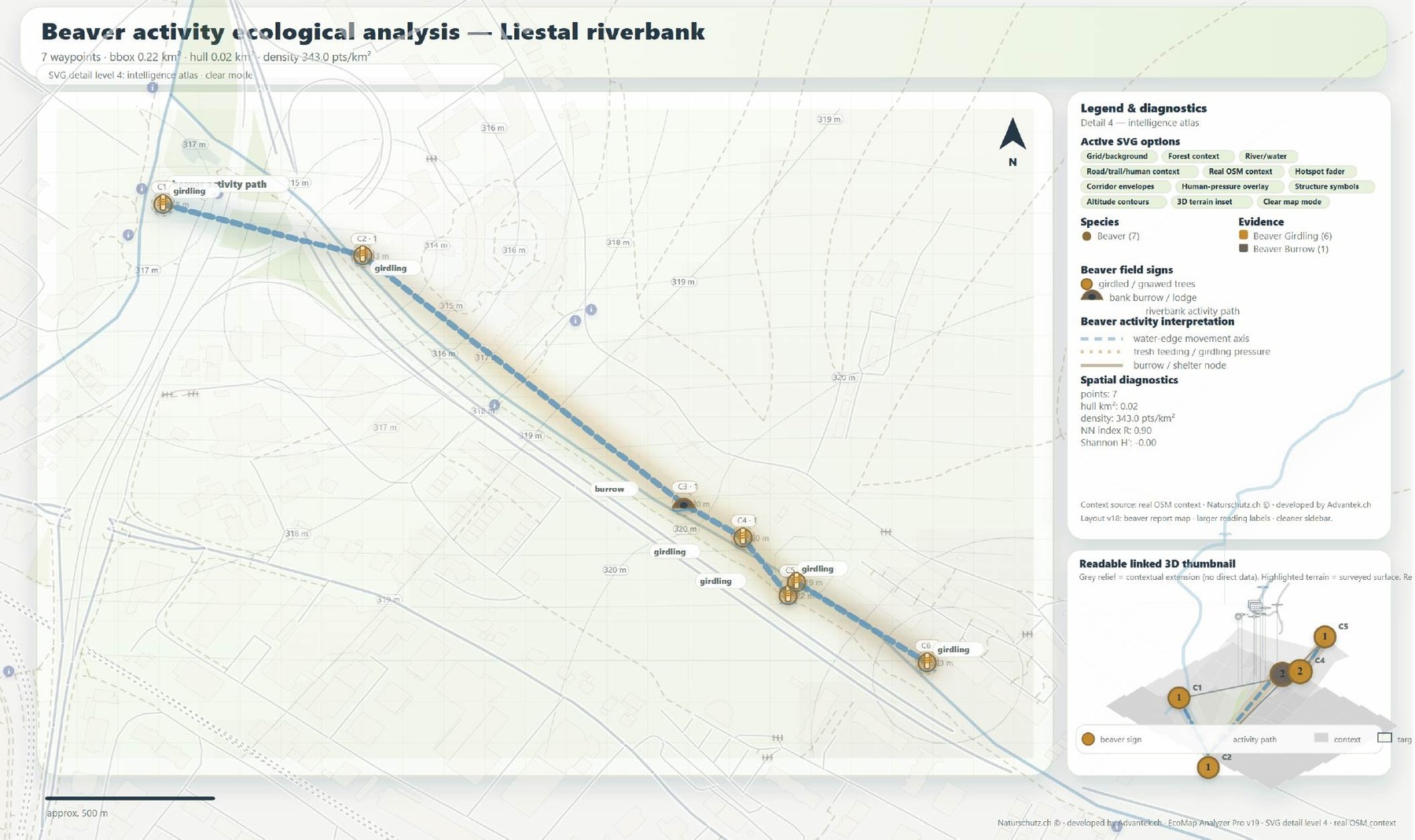
Field documentation was conducted using a non-invasive, evidence-based approach suitable for a preliminary conservation report. No animals were captured, handled, baited, or intentionally disturbed. The assessment combined repeated field visits, photographic documentation of indirect signs, and camera-trap monitoring of nocturnal activity.
Observed signs were classified into five main categories: (1) tree felling, girdling, and debarking; (2) feeding remains and fresh cutting marks; (3) slides and repeated bank access points; (4) partial dam-building or accumulation of woody material affecting local flow; and (5) direct camera-trap evidence of beaver presence. The interpretation also considered temporal continuity: signs recorded repeatedly over several months are more informative than isolated observations.
No genetic sampling, eDNA analysis, systematic population census, or confirmed reproductive survey has yet been carried out. For this reason, all conclusions are framed as probabilistic and provisional.
Woody signs
Tree felling, girdling, debarking and fresh cutting marks.
Bank access
Slides and repeated routes between water and riparian vegetation.
Hydraulic structures
Partial dam-building or woody accumulation affecting local flow.
Camera traps
Sustained nocturnal activity, including paired adult presence.
3. Méthodes
Documentation de terrain non invasive
La documentation de terrain a été réalisée selon une approche non invasive, fondée sur les indices, adaptée à un rapport préliminaire de conservation. Aucun animal n’a été capturé, manipulé, appâté ou volontairement dérangé. L’évaluation a combiné des visites répétées, une documentation photographique d’indices indirects et un suivi par pièges photographiques de l’activité nocturne.
Les indices observés ont été classés en cinq catégories principales : (1) abattage d’arbres, annelage et écorçage ; (2) restes alimentaires et marques de coupe fraîches ; (3) coulées et points d’accès répétés aux berges ; (4) construction partielle de barrage ou accumulation de bois influençant l’écoulement local ; et (5) preuves directes de présence du castor par pièges photographiques. L’interprétation a aussi pris en compte la continuité temporelle : des indices enregistrés de manière répétée pendant plusieurs mois sont plus informatifs que des observations isolées.
Aucun échantillonnage génétique, aucune analyse eDNA, aucun recensement systématique de population ni aucune enquête reproductive confirmée n’ont encore été réalisés. Pour cette raison, toutes les conclusions sont formulées comme probabilistes et provisoires.
Indices ligneux
Abattage, annelage, écorçage et marques de coupe fraîches.
Accès aux berges
Coulées et itinéraires répétés entre l’eau et la végétation riveraine.
Structures hydrauliques
Construction partielle de barrage ou accumulation de bois influençant l’écoulement local.
Pièges photographiques
Activité nocturne soutenue, incluant la présence simultanée de deux adultes.
3. Methoden
Nicht invasive Felddokumentation
Die Felddokumentation erfolgte mit einem nicht invasiven, evidenzbasierten Ansatz, der für einen vorläufigen Naturschutzbericht geeignet ist. Es wurden keine Tiere gefangen, gehandhabt, geködert oder absichtlich gestört. Die Einschätzung kombinierte wiederholte Begehungen, fotografische Dokumentation indirekter Spuren und Fotofallenmonitoring nächtlicher Aktivität.
Die beobachteten Zeichen wurden in fünf Hauptkategorien eingeteilt: (1) Baumfällung, Ringelung und Entrindung; (2) Fraßreste und frische Schnittmarken; (3) Ufergleiten und wiederholte Zugangspunkte; (4) Teilansätze von Dammbau oder Holzansammlungen, die den lokalen Abfluss beeinflussen; und (5) direkte Fotofallenhinweise auf Biberpräsenz. Die Interpretation berücksichtigte auch die zeitliche Kontinuität: Über mehrere Monate wiederholt erfasste Zeichen sind aussagekräftiger als isolierte Beobachtungen.
Genetische Probenahmen, eDNA-Analysen, systematische Populationszählungen oder bestätigte Fortpflanzungserhebungen wurden bisher nicht durchgeführt. Deshalb werden alle Schlussfolgerungen probabilistisch und vorläufig formuliert.
Holzspuren
Baumfällungen, Ringelungen, Entrindungen und frische Schnittmarken.
Uferzugänge
Gleiten und wiederholte Routen zwischen Wasser und Ufervegetation.
Hydraulische Strukturen
Teilweiser Dammbau oder Holzansammlungen mit Einfluss auf den lokalen Abfluss.
Fotofallen
Anhaltende nächtliche Aktivität, einschließlich gleichzeitiger Anwesenheit zweier erwachsener Tiere.
3. Metodi
Documentazione di campo non invasiva
La documentazione di campo è stata condotta con un approccio non invasivo, basato sulle evidenze e adatto a un rapporto preliminare di conservazione. Nessun animale è stato catturato, manipolato, attirato con esche o disturbato intenzionalmente. La valutazione ha combinato visite ripetute sul campo, documentazione fotografica di segni indiretti e monitoraggio con fototrappole dell’attività notturna.
I segni osservati sono stati classificati in cinque categorie principali: (1) abbattimento, cercinatura e scortecciamento di alberi; (2) resti alimentari e segni freschi di taglio; (3) scivoli e punti ripetuti di accesso alle sponde; (4) costruzione parziale di dighe o accumulo di materiale legnoso che influenza il flusso locale; e (5) prova diretta della presenza del castoro tramite fototrappole. L’interpretazione ha considerato anche la continuità temporale: segni registrati ripetutamente per diversi mesi sono più informativi di osservazioni isolate.
Non sono ancora stati effettuati campionamenti genetici, analisi eDNA, censimenti sistematici della popolazione o indagini riproduttive confermate. Per questo motivo tutte le conclusioni sono formulate come probabilistiche e provvisorie.
Segni su legno
Abbattimento, cercinatura, scortecciamento e segni freschi di taglio.
Accesso alle sponde
Scivoli e percorsi ripetuti tra acqua e vegetazione ripariale.
Strutture idrauliche
Costruzione parziale di dighe o accumulo di legno che influenza il flusso locale.
Fototrappole
Attività notturna sostenuta, inclusa la presenza contemporanea di due adulti.
4. Results
Repeated signs, camera-trap evidence and local pressures
4.1 Repeated field signs of beaver activity
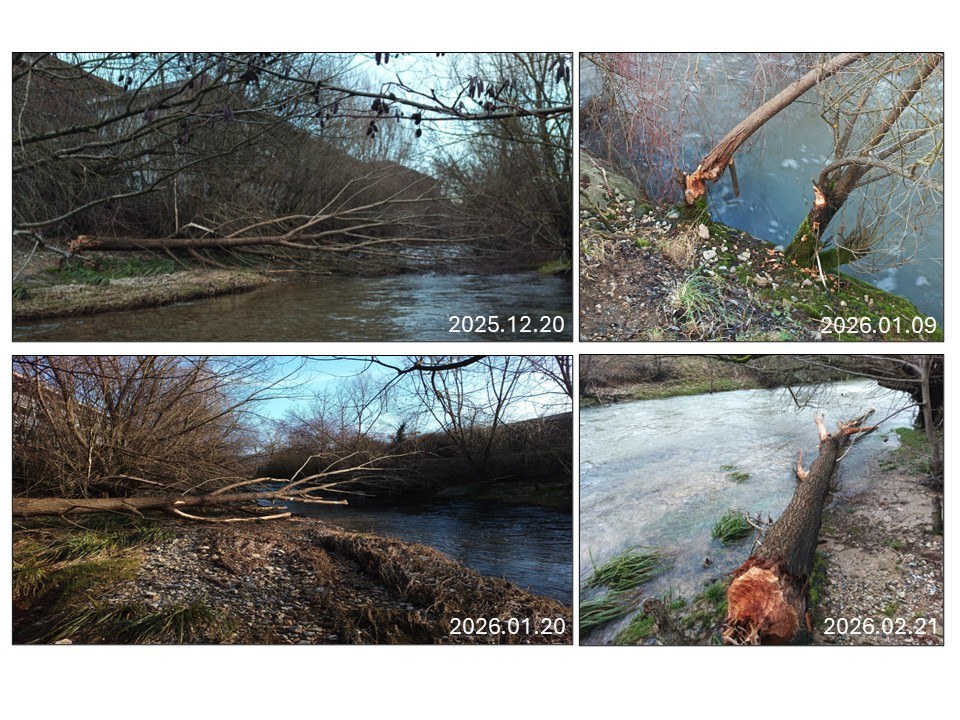
Since December 2025, repeated beaver signs have been documented along a section of the Ergolz near Liestal. The most consistent indicators were fresh and older tree-felling marks, girdled trunks, debarked branches, feeding residues, bank slides, and repeated access points between water and riparian vegetation. The signs involved several trunk diameters, suggesting more than occasional exploratory feeding.
The temporal sequence of documented signs is important. Beaver-modified wood and access structures were recorded repeatedly from December 2025 through February 2026, indicating continued use of the same river segment. Such continuity supports the interpretation of local settlement behaviour, while remaining insufficient on its own to demonstrate reproduction.
4. Résultats
Indices répétés, preuves par pièges photographiques et pressions locales
4.1 Indices répétés d’activité du castor
Depuis décembre 2025, des signes répétés de présence du castor ont été documentés le long d’un tronçon de l’Ergolz près de Liestal. Les indicateurs les plus constants étaient des marques fraîches et anciennes d’abattage, des troncs annelés, des branches écorcées, des résidus alimentaires, des coulées de berge et des points d’accès répétés entre l’eau et la végétation riveraine. Les signes concernaient plusieurs diamètres de troncs, ce qui suggère plus qu’une alimentation exploratoire occasionnelle.
La séquence temporelle des signes documentés est importante. Des bois modifiés par le castor et des structures d’accès ont été enregistrés de manière répétée de décembre 2025 à février 2026, indiquant l’utilisation continue du même segment de rivière. Cette continuité soutient l’interprétation d’un comportement local d’installation, tout en restant insuffisante à elle seule pour démontrer la reproduction.
4. Ergebnisse
Wiederholte Spuren, Fotofallenhinweise und lokale Belastungen
4.1 Wiederholte Feldspuren von Biberaktivität
Seit Dezember 2025 wurden entlang eines Abschnitts der Ergolz bei Liestal wiederholt Biberspuren dokumentiert. Die beständigsten Indikatoren waren frische und ältere Fällspuren, geringelte Stämme, entrindete Äste, Fraßreste, Ufergleiten und wiederholte Zugangspunkte zwischen Wasser und Ufervegetation. Die Zeichen betrafen mehrere Stammdurchmesser und deuten auf mehr als nur gelegentliches Erkundungsfraßverhalten hin.
Die zeitliche Abfolge der dokumentierten Zeichen ist wichtig. Von Dezember 2025 bis Februar 2026 wurden wiederholt vom Biber verändertes Holz und Zugangstrukturen erfasst, was auf eine fortgesetzte Nutzung desselben Flussabschnitts hinweist. Diese Kontinuität stützt die Interpretation eines lokalen Ansiedlungsverhaltens, reicht allein jedoch nicht aus, um Fortpflanzung nachzuweisen.
4. Risultati
Segni ripetuti, prove da fototrappole e pressioni locali
4.1 Segni ripetuti di attività del castoro
Dal dicembre 2025 sono stati documentati segni ripetuti di castoro lungo un tratto dell’Ergolz presso Liestal. Gli indicatori più costanti erano segni freschi e più vecchi di abbattimento, tronchi cercinati, rami scortecciati, residui alimentari, scivoli sulle sponde e punti di accesso ripetuti tra l’acqua e la vegetazione ripariale. I segni riguardavano diversi diametri di tronco, suggerendo più di una semplice alimentazione esplorativa occasionale.
La sequenza temporale dei segni documentati è importante. Legno modificato dal castoro e strutture di accesso sono stati registrati ripetutamente da dicembre 2025 a febbraio 2026, indicando l’uso continuativo dello stesso segmento fluviale. Questa continuità sostiene l’interpretazione di un comportamento locale di insediamento, pur restando insufficiente da sola a dimostrare la riproduzione.
4.2 Camera-trap evidence and paired adult presence
Camera-trap monitoring documented sustained nocturnal beaver activity. The strongest single observation occurred on 16 February 2026, when two adult beavers were recorded simultaneously within the same river section. In isolation, the presence of two adults does not prove reproduction, pair bonding, sex, or kinship. However, when combined with repeated engineering and feeding activity over several months, it is consistent with at least short-term territorial occupation by more than one adult rather than a purely transient dispersal event.
4.2 Preuves par pièges photographiques et présence simultanée de deux adultes
Le suivi par pièges photographiques a documenté une activité nocturne soutenue du castor. L’observation isolée la plus forte a eu lieu le 16 février 2026, lorsque deux castors adultes ont été enregistrés simultanément dans le même tronçon de rivière. Pris isolément, la présence de deux adultes ne prouve ni reproduction, ni lien de couple, ni sexe, ni parenté. Toutefois, combinée à des activités répétées d’ingénierie et d’alimentation sur plusieurs mois, elle est compatible avec une occupation territoriale au moins temporaire par plus d’un adulte, plutôt qu’avec un simple événement de dispersion transitoire.
4.2 Fotofallenhinweise und gleichzeitige Anwesenheit zweier erwachsener Tiere
Das Fotofallenmonitoring dokumentierte anhaltende nächtliche Biberaktivität. Die stärkste Einzelbeobachtung erfolgte am 16. Februar 2026, als zwei erwachsene Biber gleichzeitig im selben Flussabschnitt erfasst wurden. Isoliert betrachtet belegt die Anwesenheit zweier erwachsener Tiere weder Fortpflanzung, Paarbindung, Geschlecht noch Verwandtschaft. Zusammen mit wiederholter Bau- und Fraßaktivität über mehrere Monate ist sie jedoch mit mindestens kurzfristiger territorialer Nutzung durch mehr als ein erwachsenes Tier vereinbar und weniger mit einem rein vorübergehenden Dispersionsereignis.
4.2 Prove da fototrappole e presenza contemporanea di due adulti
Il monitoraggio con fototrappole ha documentato un’attività notturna sostenuta del castoro. L’osservazione singola più forte è avvenuta il 16 febbraio 2026, quando due castori adulti sono stati registrati simultaneamente nello stesso tratto di fiume. Da sola, la presenza di due adulti non prova riproduzione, legame di coppia, sesso o parentela. Tuttavia, quando è combinata con attività ripetute di ingegneria e alimentazione per diversi mesi, è compatibile con un’occupazione territoriale almeno a breve termine da parte di più di un adulto, piuttosto che con un evento puramente transitorio di dispersione.
Supplementary Video S1
A curated camera-trap sequence documents nocturnal beaver activity in the active Liestal river section from December 2025 to February 2026, including the final sequence with two adult individuals recorded simultaneously on 16 February 2026. Because the area is sensitive, the video should not be used to publicise precise access points or coordinates.
Vidéo complémentaire S1
Une séquence sélectionnée de piège photographique documente l’activité nocturne du castor dans le tronçon actif de Liestal entre décembre 2025 et février 2026, incluant la séquence finale avec deux adultes enregistrés simultanément le 16 février 2026. Comme le secteur est sensible, la vidéo ne doit pas être utilisée pour rendre publics des accès précis ou des coordonnées.
Ergänzendes Video S1
Eine kuratierte Fotofallen-Sequenz dokumentiert nächtliche Biberaktivität im aktiven Liestaler Flussabschnitt von Dezember 2025 bis Februar 2026, einschließlich der letzten Sequenz mit zwei gleichzeitig erfassten erwachsenen Tieren am 16. Februar 2026. Da der Bereich sensibel ist, sollte das Video nicht genutzt werden, um genaue Zugangspunkte oder Koordinaten zu veröffentlichen.
Video supplementare S1
Una sequenza selezionata da fototrappola documenta l’attività notturna del castoro nel tratto fluviale attivo di Liestal da dicembre 2025 a febbraio 2026, inclusa la sequenza finale con due adulti registrati simultaneamente il 16 febbraio 2026. Poiché l’area è sensibile, il video non deve essere usato per pubblicizzare accessi precisi o coordinate.
4.3 Local disturbance and management pressures
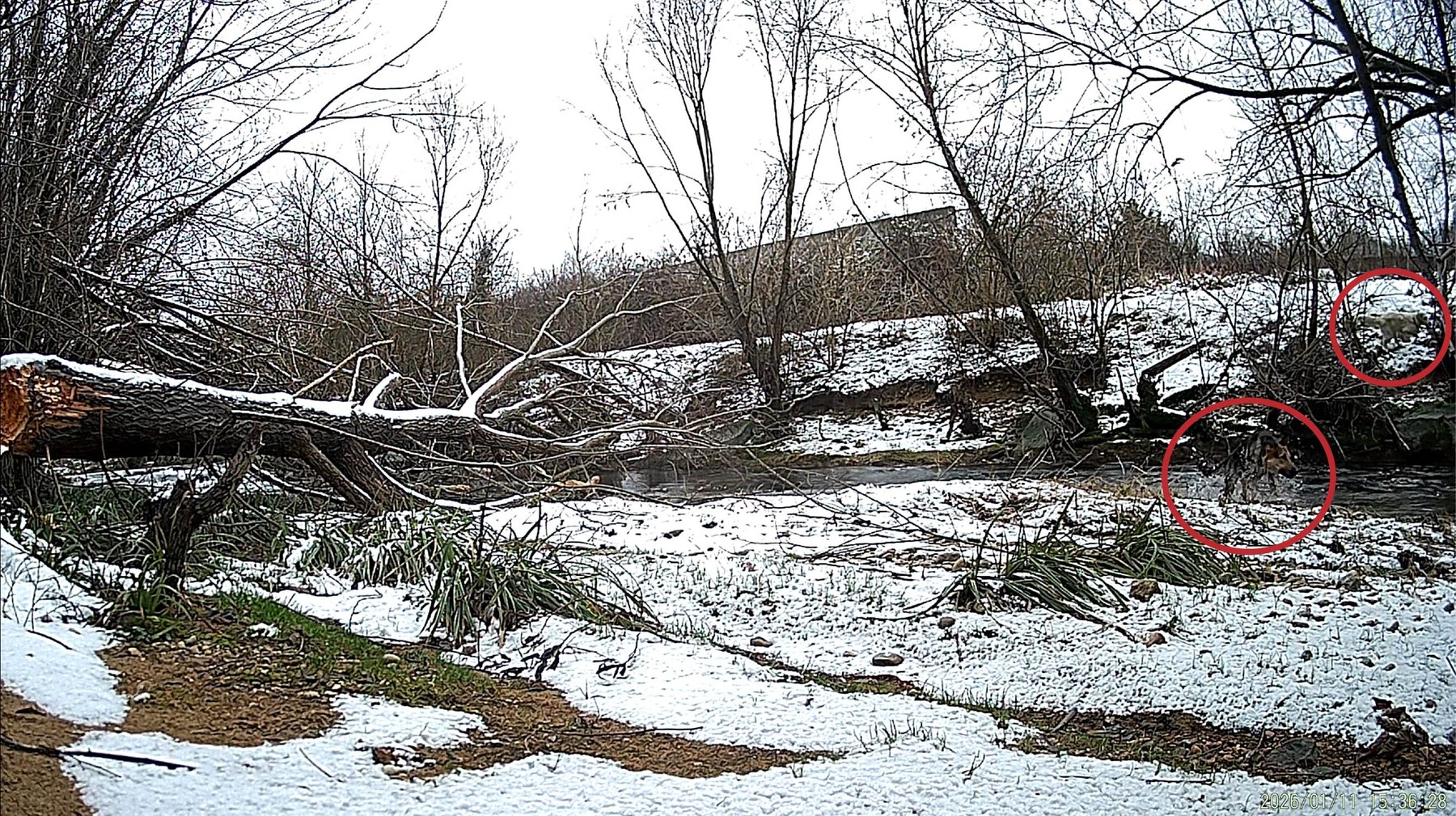
Two local pressures were noted during field documentation. First, unleashed dogs were observed crossing or entering the active river area (Figure 3). Such disturbance can disrupt repeated bank access routes, feeding areas, and nocturnal movement zones, particularly in narrow river corridors where beavers have limited alternative refuges.
4.3 Dérangements locaux et pressions de gestion
Deux pressions locales ont été notées pendant la documentation de terrain. Premièrement, des chiens non tenus en laisse ont été observés traversant ou entrant dans la zone active de la rivière (Figure 3). Un tel dérangement peut perturber les routes répétées d’accès aux berges, les zones d’alimentation et les zones de déplacement nocturne, en particulier dans les corridors fluviaux étroits où les castors disposent de peu de refuges alternatifs.
4.3 Lokale Störungen und Managementdruck
Während der Felddokumentation wurden zwei lokale Belastungen festgestellt. Erstens wurden nicht angeleinte Hunde beobachtet, die den aktiven Flussbereich querten oder betraten (Abbildung 3). Solche Störungen können wiederholte Uferzugänge, Fraßbereiche und nächtliche Bewegungszonen beeinträchtigen, insbesondere in engen Flusskorridoren, in denen Biber nur begrenzte Ausweichmöglichkeiten haben.
4.3 Disturbo locale e pressioni di gestione
Durante la documentazione di campo sono state osservate due pressioni locali. In primo luogo, cani non tenuti al guinzaglio sono stati osservati mentre attraversavano o entravano nell’area fluviale attiva (Figura 3). Questo tipo di disturbo può interrompere percorsi ripetuti di accesso alle sponde, aree di alimentazione e zone di movimento notturno, in particolare nei corridoi fluviali stretti dove i castori hanno pochi rifugi alternativi.
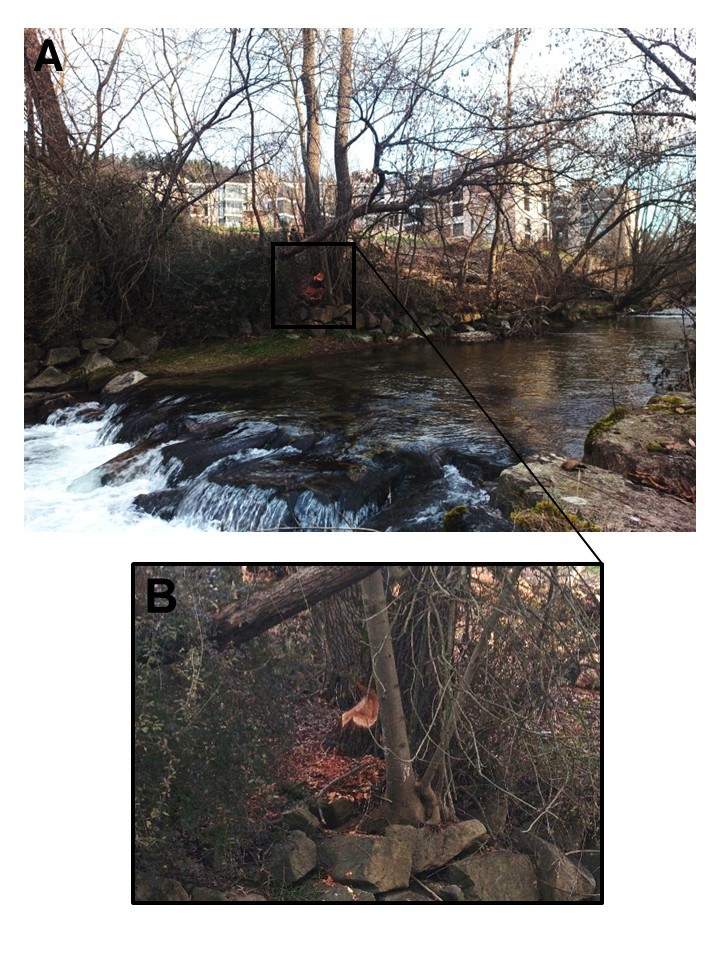
Second, some trees previously affected by beaver girdling appear to have been removed during riverbank cleaning or green-space maintenance (Figure 4). Such work may be necessary for safety or flood management, but it can also remove deadwood, erase monitoring evidence, and reduce habitat structure if conducted without ecological coordination.
Deuxièmement, certains arbres précédemment affectés par l’annelage du castor semblent avoir été retirés lors de travaux de nettoyage des berges ou d’entretien des espaces verts (Figure 4). Ces interventions peuvent être nécessaires pour la sécurité ou la gestion des crues, mais elles peuvent aussi supprimer du bois mort, effacer des preuves de suivi et réduire la structure de l’habitat si elles sont réalisées sans coordination écologique.
Zweitens scheinen einige zuvor vom Biber geringelte Bäume im Rahmen von Uferreinigungen oder Grünflächenunterhalt entfernt worden zu sein (Abbildung 4). Solche Arbeiten können aus Sicherheits- oder Hochwasserschutzgründen notwendig sein, sie können jedoch auch Totholz entfernen, Monitoringhinweise beseitigen und die Habitatstruktur reduzieren, wenn sie ohne ökologische Koordination erfolgen.
In secondo luogo, alcuni alberi precedentemente interessati dalla cercinatura del castoro sembrano essere stati rimossi durante lavori di pulizia delle sponde o manutenzione del verde (Figura 4). Tali interventi possono essere necessari per la sicurezza o la gestione delle piene, ma possono anche rimuovere legno morto, cancellare prove di monitoraggio e ridurre la struttura dell’habitat se condotti senza coordinamento ecologico.
5. Discussion
From local evidence to restoration significance
5.1 From dispersal to territorial establishment
The Liestal observations are best interpreted as evidence of probable territorial establishment, while maintaining scientific caution. The key argument is not any single sign, but the convergence of several independent indicators: repeated feeding and engineering marks, persistent activity over several months, use of the same river segment, and simultaneous presence of two adults. This combination is stronger than a one-time record of a dispersing individual.
Nevertheless, the available evidence does not yet demonstrate reproduction, colony size, genetic identity, or long-term stability. The next biologically important threshold would be documentation of breeding, such as kits, repeated family-group activity, a stable lodge or burrow complex, food cache development, or consistent winter occupation over multiple seasons.
5.2 Ecological meaning of tributary recolonisation
The return of beavers to smaller tributaries is ecologically significant because it indicates that recolonisation is moving beyond large river axes into finer-scale ecological networks. Such tributaries can reconnect aquatic and terrestrial habitats, increase structural diversity, and restore wetland processes in landscapes where floodplains have been simplified.
The Ergolz corridor near Liestal is particularly relevant because it combines ecological opportunity with human pressure. This makes it a useful case study for adaptive coexistence: the goal is not only to celebrate the return of a native species, but to manage the returning ecological processes in a way that is compatible with safety, land use, and biodiversity goals.
5.3 Beaver ecosystem engineering and hydrological resilience
Beaver activity can slow water, increase surface-water storage, promote lateral connectivity, retain sediments, and create pond-wetland mosaics. These processes can moderate peak flows, increase local water residence time, and support baseflow maintenance during dry periods. In modified river corridors, such effects may partly compensate for the loss of natural floodplain roughness and wetland storage. The magnitude of these benefits is site-specific and depends on valley shape, channel gradient, dam persistence, floodplain connectivity, and the degree of conflict with infrastructure (Puttock et al., 2021; Larsen et al., 2021).
5.4 Biodiversity benefits
By creating shallow ponds, deadwood, variable water depths, open canopy patches, and edge habitats, beavers increase habitat heterogeneity. These changes can benefit amphibians, aquatic invertebrates, riparian plants, waterbirds, bats, fish communities, and other semi-aquatic mammals. In a narrow river system such as the Ergolz, even small structural changes may create important microhabitats if they are allowed to persist safely (Orazi et al., 2022; Brazier et al., 2021).
The ecological value of beaver activity is therefore not limited to the presence of the animal itself. The beaver acts as a process-restoration agent: it modifies physical habitat, and many other species respond to the new habitat conditions that follow.
5.5 Carbon storage and water quality
Recent research from a beaver-influenced stream corridor in Switzerland suggests that beaver wetlands can function as substantial carbon sinks under some conditions. However, carbon balance is complex: beaver wetlands may store carbon in sediment, biomass, and deadwood while also emitting carbon dioxide or methane seasonally. The most defensible interpretation is therefore cautious: beaver-created wetlands can contribute to nature-based climate and water-quality functions, but carbon outcomes should not be assumed without site-specific measurement (Hallberg et al., 2026; Thompson et al., 2021).
At the local scale, ponding and flow reduction can also trap suspended sediment and nutrients, improving downstream water quality in some contexts. These services reinforce the need to consider beaver activity as part of catchment-scale restoration planning rather than only as a wildlife-management issue (Thompson et al., 2021).
5.6 Human-wildlife coexistence
Beaver recovery inevitably creates local challenges. Potential conflicts include flooding of paths or fields, tree damage, blocked culverts, bank instability, and interactions with dogs or recreational users. These conflicts should not be ignored, but neither should they lead to premature removal of ecological structures. Adaptive management can combine targeted mitigation with conservation: selective tree protection, flow devices where appropriate, careful culvert management, signage, seasonal monitoring, and coordination between municipal services, landowners, wildlife authorities, and conservation groups.
5.7 Limitations
This report is based on repeated but opportunistic field observations rather than a formal population census. It lacks genetic confirmation, systematic occupancy modelling, direct evidence of reproduction, and independent confirmation of individual identity. For this reason, the study should be read as a cautious local evidence note: it identifies a probable emerging territory and a management priority, not a confirmed breeding colony.
5. Discussion
Des indices locaux à l’importance pour la restauration
5.1 De la dispersion à l’installation territoriale
Les observations de Liestal sont mieux interprétées comme des indices d’une probable installation territoriale, tout en conservant une prudence scientifique. L’argument principal ne repose pas sur un seul signe, mais sur la convergence de plusieurs indicateurs indépendants : marques répétées d’alimentation et d’ingénierie, activité persistante sur plusieurs mois, utilisation du même segment de rivière et présence simultanée de deux adultes. Cette combinaison est plus forte qu’un enregistrement unique d’un individu en dispersion.
Les preuves disponibles ne démontrent toutefois pas encore la reproduction, la taille de la colonie, l’identité génétique ou la stabilité à long terme. Le prochain seuil biologiquement important serait la documentation d’une reproduction, par exemple des jeunes, une activité répétée de groupe familial, une hutte ou un complexe de terriers stable, un développement de réserve alimentaire ou une occupation hivernale constante sur plusieurs saisons.
5.2 Signification écologique de la recolonisation des affluents
Le retour des castors dans les petits affluents est écologiquement important, car il indique que la recolonisation dépasse les grands axes fluviaux pour atteindre des réseaux écologiques plus fins. Ces affluents peuvent reconnecter les habitats aquatiques et terrestres, augmenter la diversité structurelle et restaurer des processus de zones humides dans des paysages où les plaines alluviales ont été simplifiées.
Le corridor de l’Ergolz près de Liestal est particulièrement pertinent parce qu’il combine opportunité écologique et pression humaine. Il constitue ainsi un cas d’étude utile pour une coexistence adaptative : l’objectif n’est pas seulement de célébrer le retour d’une espèce indigène, mais de gérer les processus écologiques qui reviennent d’une manière compatible avec la sécurité, les usages du sol et les objectifs de biodiversité.
5.3 Ingénierie écosystémique du castor et résilience hydrologique
L’activité du castor peut ralentir l’eau, accroître le stockage d’eau de surface, favoriser la connectivité latérale, retenir les sédiments et créer des mosaïques d’étangs et de zones humides. Ces processus peuvent modérer les pics de crue, augmenter le temps de résidence local de l’eau et soutenir les débits de base pendant les périodes sèches. Dans des corridors fluviaux modifiés, ces effets peuvent compenser partiellement la perte de rugosité naturelle des plaines alluviales et de stockage humide. L’ampleur de ces bénéfices dépend du site, de la forme de la vallée, de la pente du chenal, de la persistance des barrages, de la connectivité de la plaine alluviale et du degré de conflit avec les infrastructures (Puttock et al., 2021 ; Larsen et al., 2021).
5.4 Bénéfices pour la biodiversité
En créant des étangs peu profonds, du bois mort, des profondeurs d’eau variables, des ouvertures de canopée et des habitats de lisière, les castors augmentent l’hétérogénéité des habitats. Ces changements peuvent bénéficier aux amphibiens, invertébrés aquatiques, plantes riveraines, oiseaux d’eau, chauves-souris, communautés de poissons et autres mammifères semi-aquatiques. Dans un système fluvial étroit comme l’Ergolz, même de petites modifications structurelles peuvent créer des microhabitats importants si elles peuvent persister en sécurité (Orazi et al., 2022 ; Brazier et al., 2021).
La valeur écologique de l’activité du castor ne se limite donc pas à la présence de l’animal lui-même. Le castor agit comme un agent de restauration des processus : il modifie l’habitat physique, et de nombreuses autres espèces répondent aux nouvelles conditions d’habitat qui en résultent.
5.5 Stockage du carbone et qualité de l’eau
Des recherches récentes menées dans un corridor de cours d’eau influencé par le castor en Suisse suggèrent que les zones humides créées par le castor peuvent fonctionner comme des puits de carbone substantiels dans certaines conditions. Toutefois, le bilan carbone est complexe : ces zones peuvent stocker du carbone dans les sédiments, la biomasse et le bois mort, tout en émettant saisonnièrement du dioxyde de carbone ou du méthane. L’interprétation la plus défendable reste donc prudente : les zones humides créées par le castor peuvent contribuer à des fonctions climatiques et de qualité de l’eau fondées sur la nature, mais les résultats carbone ne doivent pas être supposés sans mesure spécifique au site (Hallberg et al., 2026 ; Thompson et al., 2021).
À l’échelle locale, la mise en eau et la réduction du courant peuvent aussi piéger des sédiments et des nutriments en suspension, améliorant la qualité de l’eau en aval dans certains contextes. Ces services renforcent la nécessité de considérer l’activité du castor dans une planification de restauration à l’échelle du bassin versant, et non seulement comme une question de gestion de la faune (Thompson et al., 2021).
5.6 Coexistence humain-faune sauvage
Le retour du castor crée inévitablement des défis locaux. Les conflits potentiels incluent l’inondation de chemins ou de champs, les dégâts aux arbres, l’obstruction de buses, l’instabilité des berges et les interactions avec les chiens ou les usagers récréatifs. Ces conflits ne doivent pas être ignorés, mais ils ne devraient pas non plus conduire à la suppression prématurée de structures écologiques. Une gestion adaptative peut combiner mesures ciblées et conservation : protection sélective des arbres, dispositifs de régulation du débit lorsque cela est approprié, gestion attentive des buses, signalétique, suivi saisonnier et coordination entre services communaux, propriétaires, autorités de la faune et groupes de conservation.
5.7 Limites
Ce rapport repose sur des observations de terrain répétées mais opportunistes, et non sur un recensement formel de population. Il manque une confirmation génétique, une modélisation systématique de l’occupation, une preuve directe de reproduction et une confirmation indépendante de l’identité individuelle. Pour cette raison, l’étude doit être lue comme une note locale prudente : elle identifie un territoire probablement émergent et une priorité de gestion, non une colonie reproductrice confirmée.
5. Diskussion
Von lokalen Hinweisen zur Bedeutung für die Restaurierung
5.1 Von Dispersion zu territorialer Etablierung
Die Beobachtungen bei Liestal sind am besten als Hinweise auf eine wahrscheinliche territoriale Etablierung zu verstehen, wobei wissenschaftliche Vorsicht notwendig bleibt. Das zentrale Argument ist nicht ein einzelnes Zeichen, sondern die Konvergenz mehrerer unabhängiger Indikatoren: wiederholte Fraß- und Bauspuren, anhaltende Aktivität über mehrere Monate, Nutzung desselben Flussabschnitts und gleichzeitige Anwesenheit zweier erwachsener Tiere. Diese Kombination ist stärker als ein einmaliger Nachweis eines ausbreitenden Individuums.
Dennoch belegen die verfügbaren Hinweise bisher weder Fortpflanzung, Koloniegröße, genetische Identität noch langfristige Stabilität. Die nächste biologisch wichtige Schwelle wäre der Nachweis von Fortpflanzung, etwa durch Jungtiere, wiederholte Familiengruppenaktivität, einen stabilen Bau- oder Erdbaukomplex, die Entwicklung eines Nahrungsvorrats oder eine konstante Winterbesetzung über mehrere Jahreszeiten.
5.2 Ökologische Bedeutung der Wiederbesiedlung von Zuflüssen
Die Rückkehr des Bibers in kleinere Zuflüsse ist ökologisch bedeutsam, weil sie zeigt, dass die Wiederbesiedlung über grosse Flussachsen hinaus in feinere ökologische Netzwerke vordringt. Solche Zuflüsse können aquatische und terrestrische Lebensräume wieder verbinden, die strukturelle Vielfalt erhöhen und Feuchtgebietsprozesse in Landschaften wiederherstellen, deren Auen vereinfacht wurden.
Der Ergolz-Korridor bei Liestal ist besonders relevant, weil er ökologische Chancen mit menschlichem Druck verbindet. Damit eignet er sich als Fallbeispiel für adaptive Koexistenz: Ziel ist nicht nur, die Rückkehr einer einheimischen Art zu begrüssen, sondern die zurückkehrenden ökologischen Prozesse so zu managen, dass sie mit Sicherheit, Landnutzung und Biodiversitätszielen vereinbar sind.
5.3 Ökosystemgestaltung durch Biber und hydrologische Resilienz
Biberaktivität kann Wasser verlangsamen, Oberflächenwasserspeicherung erhöhen, laterale Vernetzung fördern, Sedimente zurückhalten und Mosaike aus Teichen und Feuchtgebieten schaffen. Diese Prozesse können Hochwasserspitzen dämpfen, die lokale Verweilzeit des Wassers erhöhen und Basisabflüsse in Trockenperioden unterstützen. In veränderten Flusskorridoren können solche Effekte den Verlust natürlicher Auenrauigkeit und Feuchtgebietsspeicherung teilweise ausgleichen. Das Ausmaß dieser Vorteile ist standortspezifisch und hängt von Talform, Gerinnegefälle, Dammbeständigkeit, Auenkonnektivität und dem Konfliktgrad mit Infrastruktur ab (Puttock et al., 2021; Larsen et al., 2021).
5.4 Vorteile für die Biodiversität
Durch die Schaffung flacher Teiche, Totholz, unterschiedlicher Wassertiefen, offener Kronenbereiche und Randhabitate erhöhen Biber die Habitatheterogenität. Diese Veränderungen können Amphibien, aquatische Wirbellose, Uferpflanzen, Wasservögel, Fledermäuse, Fischgemeinschaften und andere semiaquatische Säugetiere fördern. In einem engen Flusssystem wie der Ergolz können selbst kleine Strukturveränderungen wichtige Mikrohabitate schaffen, wenn sie sicher bestehen bleiben dürfen (Orazi et al., 2022; Brazier et al., 2021).
Der ökologische Wert der Biberaktivität beschränkt sich daher nicht auf die Anwesenheit des Tieres selbst. Der Biber wirkt als Prozess-Restaurationsakteur: Er verändert den physischen Lebensraum, und viele andere Arten reagieren auf die neuen Habitatbedingungen, die daraus entstehen.
5.5 Kohlenstoffspeicherung und Wasserqualität
Aktuelle Forschung aus einem biberbeeinflussten Bachkorridor in der Schweiz deutet darauf hin, dass Biberfeuchtgebiete unter bestimmten Bedingungen als erhebliche Kohlenstoffsenken funktionieren können. Die Kohlenstoffbilanz ist jedoch komplex: Biberfeuchtgebiete können Kohlenstoff in Sediment, Biomasse und Totholz speichern, gleichzeitig aber saisonal Kohlendioxid oder Methan emittieren. Die vorsichtigste Interpretation lautet daher: Durch Biber geschaffene Feuchtgebiete können zu naturbasierten Klima- und Wasserqualitätsfunktionen beitragen, aber Kohlenstoffwirkungen sollten ohne standortspezifische Messungen nicht angenommen werden (Hallberg et al., 2026; Thompson et al., 2021).
Auf lokaler Ebene können Aufstauung und Abflussverlangsamung auch Schwebstoffe und Nährstoffe zurückhalten und in manchen Kontexten die Wasserqualität flussabwärts verbessern. Diese Leistungen unterstreichen die Notwendigkeit, Biberaktivität als Teil einer einzugsgebietsweiten Restaurierungsplanung zu betrachten und nicht nur als Wildtiermanagementproblem (Thompson et al., 2021).
5.6 Mensch-Wildtier-Koexistenz
Die Bibererholung bringt zwangsläufig lokale Herausforderungen mit sich. Mögliche Konflikte umfassen Überflutung von Wegen oder Feldern, Baumschäden, blockierte Durchlässe, Uferinstabilität und Interaktionen mit Hunden oder Erholungssuchenden. Diese Konflikte sollten nicht ignoriert werden, sollten aber auch nicht zu einer vorschnellen Entfernung ökologischer Strukturen führen. Adaptives Management kann gezielte Minderung mit Naturschutz verbinden: selektiver Baumschutz, wo angemessen Abflussregler, sorgfältiges Durchlassmanagement, Beschilderung, saisonales Monitoring und Koordination zwischen Gemeindediensten, Landbesitzern, Wildtierbehörden und Naturschutzgruppen.
5.7 Einschränkungen
Dieser Bericht basiert auf wiederholten, aber opportunistischen Feldbeobachtungen und nicht auf einer formalen Populationszählung. Es fehlen genetische Bestätigung, systematische Besiedlungsmodellierung, direkter Fortpflanzungsnachweis und unabhängige Bestätigung individueller Identität. Aus diesem Grund ist die Studie als vorsichtige lokale Evidenznotiz zu lesen: Sie identifiziert ein wahrscheinlich entstehendes Revier und eine Managementpriorität, nicht eine bestätigte Fortpflanzungskolonie.
5. Discussione
Dalle evidenze locali al significato per il ripristino
5.1 Dalla dispersione alla stabilizzazione territoriale
Le osservazioni di Liestal sono interpretabili al meglio come evidenze di probabile stabilizzazione territoriale, mantenendo però cautela scientifica. L’argomento principale non è un singolo segno, ma la convergenza di diversi indicatori indipendenti: segni ripetuti di alimentazione e ingegneria, attività persistente per diversi mesi, uso dello stesso segmento fluviale e presenza simultanea di due adulti. Questa combinazione è più forte di una singola registrazione di un individuo in dispersione.
Tuttavia, le evidenze disponibili non dimostrano ancora riproduzione, dimensione della colonia, identità genetica o stabilità a lungo termine. La prossima soglia biologicamente importante sarebbe la documentazione della riproduzione, come cuccioli, attività ripetuta di gruppo familiare, una tana o complesso di tane stabile, sviluppo di scorte alimentari o occupazione invernale costante su più stagioni.
5.2 Significato ecologico della ricolonizzazione dei tributari
Il ritorno dei castori nei tributari più piccoli è ecologicamente significativo perché indica che la ricolonizzazione si sta spostando oltre i grandi assi fluviali verso reti ecologiche più fini. Tali tributari possono riconnettere habitat acquatici e terrestri, aumentare la diversità strutturale e ripristinare processi di zone umide in paesaggi dove le pianure alluvionali sono state semplificate.
Il corridoio dell’Ergolz presso Liestal è particolarmente rilevante perché combina opportunità ecologica e pressione umana. Diventa così un utile caso di studio per la coesistenza adattativa: l’obiettivo non è solo celebrare il ritorno di una specie autoctona, ma gestire i processi ecologici che ritornano in modo compatibile con sicurezza, uso del suolo e obiettivi di biodiversità.
5.3 Ingegneria ecosistemica del castoro e resilienza idrologica
L’attività del castoro può rallentare l’acqua, aumentare lo stoccaggio di acqua superficiale, favorire la connettività laterale, trattenere sedimenti e creare mosaici di stagni e zone umide. Questi processi possono moderare i picchi di piena, aumentare il tempo di residenza locale dell’acqua e sostenere i deflussi di base durante i periodi secchi. Nei corridoi fluviali modificati, tali effetti possono compensare in parte la perdita di rugosità naturale delle pianure alluvionali e di capacità di stoccaggio umido. L’entità di questi benefici è specifica del sito e dipende da forma della valle, pendenza del canale, persistenza delle dighe, connettività della pianura alluvionale e grado di conflitto con le infrastrutture (Puttock et al., 2021; Larsen et al., 2021).
5.4 Benefici per la biodiversità
Creando stagni poco profondi, legno morto, profondità d’acqua variabili, aperture nella copertura arborea e habitat di margine, i castori aumentano l’eterogeneità degli habitat. Questi cambiamenti possono favorire anfibi, invertebrati acquatici, piante ripariali, uccelli acquatici, pipistrelli, comunità ittiche e altri mammiferi semiacquatici. In un sistema fluviale stretto come l’Ergolz, anche piccoli cambiamenti strutturali possono creare microhabitat importanti se possono persistere in sicurezza (Orazi et al., 2022; Brazier et al., 2021).
Il valore ecologico dell’attività del castoro non si limita quindi alla presenza dell’animale stesso. Il castoro agisce come agente di ripristino dei processi: modifica l’habitat fisico e molte altre specie rispondono alle nuove condizioni che ne derivano.
5.5 Stoccaggio del carbonio e qualità dell’acqua
Ricerche recenti da un corridoio fluviale influenzato dal castoro in Svizzera suggeriscono che le zone umide create dai castori possano funzionare come importanti pozzi di carbonio in alcune condizioni. Tuttavia, il bilancio del carbonio è complesso: le zone umide dei castori possono immagazzinare carbonio in sedimenti, biomassa e legno morto, emettendo al tempo stesso anidride carbonica o metano stagionalmente. L’interpretazione più difendibile è quindi prudente: le zone umide create dai castori possono contribuire a funzioni climatiche e di qualità dell’acqua basate sulla natura, ma gli esiti sul carbonio non devono essere presupposti senza misure specifiche del sito (Hallberg et al., 2026; Thompson et al., 2021).
A scala locale, l’invaso e la riduzione del flusso possono anche trattenere sedimenti sospesi e nutrienti, migliorando in alcuni contesti la qualità dell’acqua a valle. Questi servizi rafforzano la necessità di considerare l’attività del castoro come parte della pianificazione del ripristino a scala di bacino, non solo come questione di gestione faunistica (Thompson et al., 2021).
5.6 Coesistenza uomo-fauna selvatica
Il recupero del castoro crea inevitabilmente sfide locali. I potenziali conflitti includono allagamento di sentieri o campi, danni agli alberi, ostruzione di tombini, instabilità delle sponde e interazioni con cani o utenti ricreativi. Questi conflitti non devono essere ignorati, ma non dovrebbero nemmeno portare alla rimozione prematura di strutture ecologiche. La gestione adattativa può combinare mitigazione mirata e conservazione: protezione selettiva degli alberi, dispositivi di regolazione del flusso dove appropriato, gestione attenta dei tombini, segnaletica, monitoraggio stagionale e coordinamento tra servizi comunali, proprietari, autorità faunistiche e gruppi di conservazione.
5.7 Limiti
Questo rapporto si basa su osservazioni di campo ripetute ma opportunistiche, non su un censimento formale della popolazione. Mancano conferma genetica, modellazione sistematica dell’occupazione, prova diretta di riproduzione e conferma indipendente dell’identità individuale. Per questo motivo lo studio va letto come una nota locale prudente: identifica un probabile territorio emergente e una priorità gestionale, non una colonia riproduttiva confermata.
6. Conservation and monitoring recommendations
Confirm the biological status of the site while reducing disturbance
The following actions are proposed for the Ergolz section near Liestal. They are designed to confirm the biological status of the site while reducing disturbance and preventing avoidable conflicts.
| Objective | Recommended action | Reason |
|---|---|---|
| Confirm territorial stability | Continue camera-trapping and winter sign surveys using fixed observation points and consistent date records. | Separates repeated territorial use from occasional dispersal. |
| Confirm reproduction | Monitor cautiously for kits or family-group activity during the breeding season without approaching dens, burrows, or active resting sites. | Reproduction would confirm colony establishment rather than paired occupancy only. |
| Improve evidence quality | Where feasible, collect non-invasive genetic material or eDNA in collaboration with appropriate authorities or specialists. | Can confirm species identity, individual identity, kinship, and repeated use. |
| Reduce disturbance | Install clear public-awareness signage and encourage or require dogs to remain on leash near active beaver zones. | Protects bank access points, feeding areas, and nocturnal refuge routes. |
| Coordinate maintenance | Before removing beaver-modified trees or woody structures, consult wildlife authorities and retain deadwood where safety allows. | Maintains habitat value and avoids destroying evidence or ecological function unnecessarily. |
| Prevent conflicts early | Use targeted mitigation such as selective tree guards, culvert checks, or water-level devices only where infrastructure risk is documented. | Supports coexistence without suppressing ecological benefits. |
| Strengthen habitat resilience | Maintain riparian buffers, allow willow, poplar, and alder regeneration, and avoid excessive bank simplification. | Improves food resources, bank stability, and biodiversity response. |
6. Recommandations de conservation et de suivi
Confirmer le statut biologique du site tout en réduisant le dérangement
Les actions suivantes sont proposées pour le tronçon de l’Ergolz près de Liestal. Elles visent à confirmer le statut biologique du site tout en réduisant le dérangement et en prévenant les conflits évitables.
| Objectif | Action recommandée | Raison |
|---|---|---|
| Confirmer la stabilité territoriale | Poursuivre les pièges photographiques et les relevés hivernaux d’indices à partir de points d’observation fixes avec des dates cohérentes. | Distingue une utilisation territoriale répétée d’une dispersion occasionnelle. |
| Confirmer la reproduction | Surveiller prudemment les jeunes ou l’activité de groupe familial pendant la saison de reproduction, sans s’approcher des terriers, huttes ou sites de repos actifs. | La reproduction confirmerait l’établissement d’une colonie et non seulement une occupation par deux adultes. |
| Améliorer la qualité des preuves | Lorsque cela est possible, collecter du matériel génétique non invasif ou de l’eDNA en collaboration avec les autorités ou spécialistes compétents. | Peut confirmer l’espèce, l’identité individuelle, la parenté et l’utilisation répétée. |
| Réduire le dérangement | Installer une signalétique claire de sensibilisation et encourager ou exiger la tenue des chiens en laisse près des zones actives du castor. | Protège les accès aux berges, les zones d’alimentation et les voies de refuge nocturnes. |
| Coordonner l’entretien | Avant de retirer des arbres modifiés par le castor ou des structures ligneuses, consulter les autorités de la faune et conserver le bois mort lorsque la sécurité le permet. | Maintient la valeur d’habitat et évite de détruire inutilement des preuves ou des fonctions écologiques. |
| Prévenir les conflits tôt | Utiliser des mesures ciblées comme des protections sélectives d’arbres, des contrôles de buses ou des dispositifs de niveau d’eau uniquement lorsqu’un risque pour les infrastructures est documenté. | Soutient la coexistence sans supprimer les bénéfices écologiques. |
| Renforcer la résilience de l’habitat | Maintenir les bandes riveraines, permettre la régénération du saule, du peuplier et de l’aulne, et éviter une simplification excessive des berges. | Améliore les ressources alimentaires, la stabilité des berges et la réponse de la biodiversité. |
6. Empfehlungen für Schutz und Monitoring
Den biologischen Status des Standorts bestätigen und Störungen reduzieren
Die folgenden Maßnahmen werden für den Ergolz-Abschnitt bei Liestal vorgeschlagen. Sie sollen den biologischen Status des Standorts bestätigen, Störungen reduzieren und vermeidbare Konflikte verhindern.
| Ziel | Empfohlene Maßnahme | Begründung |
|---|---|---|
| Territoriale Stabilität bestätigen | Fotofallen und Winterspurensuchen mit festen Beobachtungspunkten und konsistenten Datumsaufzeichnungen fortsetzen. | Trennt wiederholte territoriale Nutzung von gelegentlicher Dispersion. |
| Fortpflanzung bestätigen | Während der Fortpflanzungszeit vorsichtig nach Jungtieren oder Familiengruppenaktivität suchen, ohne Baue, Erdbauten oder aktive Ruheplätze aufzusuchen. | Fortpflanzung würde Kolonieetablierung bestätigen und nicht nur Nutzung durch zwei erwachsene Tiere. |
| Beweisqualität verbessern | Wo möglich, nicht invasives genetisches Material oder eDNA in Zusammenarbeit mit zuständigen Behörden oder Fachpersonen sammeln. | Kann Artidentität, individuelle Identität, Verwandtschaft und wiederholte Nutzung bestätigen. |
| Störung reduzieren | Klare Sensibilisierungsschilder aufstellen und Hunde in aktiven Biberzonen an der Leine führen lassen oder verlangen. | Schützt Uferzugänge, Fraßbereiche und nächtliche Rückzugsrouten. |
| Unterhalt koordinieren | Vor dem Entfernen von vom Biber veränderten Bäumen oder Holzstrukturen Wildtierbehörden konsultieren und Totholz erhalten, wo es die Sicherheit erlaubt. | Erhält Habitatwert und vermeidet unnötige Zerstörung von Hinweisen oder ökologischen Funktionen. |
| Konflikte früh verhindern | Gezielte Maßnahmen wie selektive Baumschutzgitter, Durchlasskontrollen oder Wasserstandsregler nur dort einsetzen, wo ein Infrastrukturrisiko dokumentiert ist. | Unterstützt Koexistenz, ohne ökologische Vorteile zu unterdrücken. |
| Habitatresilienz stärken | Uferpuffer erhalten, Weiden-, Pappel- und Erlenverjüngung zulassen und übermäßige Ufervereinfachung vermeiden. | Verbessert Nahrungsressourcen, Uferstabilität und Biodiversitätsreaktion. |
6. Raccomandazioni di conservazione e monitoraggio
Confermare lo stato biologico del sito riducendo il disturbo
Le azioni seguenti sono proposte per il tratto dell’Ergolz presso Liestal. Sono pensate per confermare lo stato biologico del sito riducendo il disturbo e prevenendo conflitti evitabili.
| Obiettivo | Azione raccomandata | Motivo |
|---|---|---|
| Confermare la stabilità territoriale | Continuare le fototrappole e i rilievi invernali dei segni usando punti di osservazione fissi e registrazioni coerenti delle date. | Distingue l’uso territoriale ripetuto dalla dispersione occasionale. |
| Confermare la riproduzione | Monitorare con cautela eventuali piccoli o attività di gruppo familiare durante la stagione riproduttiva, senza avvicinarsi a tane, rifugi o siti di riposo attivi. | La riproduzione confermerebbe l’insediamento della colonia e non solo l’occupazione da parte di due adulti. |
| Migliorare la qualità delle prove | Dove possibile, raccogliere materiale genetico non invasivo o eDNA in collaborazione con autorità o specialisti competenti. | Può confermare specie, identità individuale, parentela e uso ripetuto. |
| Ridurre il disturbo | Installare segnaletica chiara di sensibilizzazione e incoraggiare o richiedere il guinzaglio per i cani vicino alle zone attive del castoro. | Protegge punti di accesso alle sponde, aree di alimentazione e vie di rifugio notturne. |
| Coordinare la manutenzione | Prima di rimuovere alberi modificati dal castoro o strutture legnose, consultare le autorità faunistiche e conservare il legno morto dove la sicurezza lo consente. | Mantiene il valore dell’habitat ed evita di distruggere inutilmente prove o funzioni ecologiche. |
| Prevenire presto i conflitti | Usare mitigazioni mirate come protezioni selettive degli alberi, controlli dei tombini o dispositivi di livello dell’acqua solo dove il rischio per le infrastrutture è documentato. | Sostiene la coesistenza senza sopprimere i benefici ecologici. |
| Rafforzare la resilienza dell’habitat | Mantenere fasce ripariali, permettere la rigenerazione di salici, pioppi e ontani ed evitare un’eccessiva semplificazione delle sponde. | Migliora risorse alimentari, stabilità delle sponde e risposta della biodiversità. |
7. Conclusion
A local step in the recovery of Castor fiber in Switzerland
The probable territorial occupation of the Ergolz near Liestal by at least two adult Eurasian beavers represents a locally significant step in the continuing recovery of Castor fiber in Switzerland. More than the return of a single species, the event signals the gradual restoration of ecological processes — wood recruitment, wetland creation, hydrological buffering, sediment retention, and habitat diversification — that have been missing or reduced in many managed river landscapes.
The evidence remains provisional, and reproduction has not yet been demonstrated. A careful monitoring programme is therefore essential. If managed with ecological sensitivity, the Liestal site could become an important local example of adaptive river restoration, showing how a native ecosystem engineer can contribute to biodiversity and climate resilience even within a human-modified landscape.
Public awareness is now a priority. Keeping dogs on leash in sensitive sections, coordinating riverbank maintenance, and explaining the ecological role of beavers can help prevent avoidable disturbance while supporting the natural recovery of the Ergolz corridor.
7. Conclusion
Une étape locale dans le rétablissement de Castor fiber en Suisse
L’occupation territoriale probable de l’Ergolz près de Liestal par au moins deux castors d’Europe adultes représente une étape localement significative dans le rétablissement continu de Castor fiber en Suisse. Plus que le retour d’une seule espèce, l’événement signale la restauration progressive de processus écologiques — recrutement de bois, création de zones humides, tamponnement hydrologique, rétention des sédiments et diversification de l’habitat — qui ont disparu ou été réduits dans de nombreux paysages fluviaux gérés.
Les preuves restent provisoires et la reproduction n’a pas encore été démontrée. Un programme de suivi prudent est donc essentiel. Si le site de Liestal est géré avec sensibilité écologique, il pourrait devenir un exemple local important de restauration adaptative de rivière, montrant comment un ingénieur écosystémique indigène peut contribuer à la biodiversité et à la résilience climatique même dans un paysage modifié par l’humain.
La sensibilisation du public est désormais une priorité. Tenir les chiens en laisse dans les secteurs sensibles, coordonner l’entretien des berges et expliquer le rôle écologique des castors peuvent aider à prévenir les dérangements évitables tout en soutenant le rétablissement naturel du corridor de l’Ergolz.
7. Schlussfolgerung
Ein lokaler Schritt in der Erholung von Castor fiber in der Schweiz
Die wahrscheinliche territoriale Nutzung der Ergolz bei Liestal durch mindestens zwei erwachsene Europäische Biber stellt einen lokal bedeutsamen Schritt in der fortlaufenden Erholung von Castor fiber in der Schweiz dar. Mehr als die Rückkehr einer einzelnen Art signalisiert das Ereignis die schrittweise Wiederherstellung ökologischer Prozesse — Holzeintrag, Feuchtgebietsbildung, hydrologische Pufferung, Sedimentrückhalt und Habitatdiversifizierung — die in vielen bewirtschafteten Flusslandschaften fehlen oder reduziert sind.
Die Hinweise bleiben vorläufig, und Fortpflanzung wurde noch nicht nachgewiesen. Ein sorgfältiges Monitoringprogramm ist daher wesentlich. Wird der Liestaler Standort ökologisch sensibel gemanagt, könnte er zu einem wichtigen lokalen Beispiel adaptiver Flussrestaurierung werden und zeigen, wie ein einheimischer Ökosystemingenieur selbst in einer menschlich veränderten Landschaft zu Biodiversität und Klimaresilienz beitragen kann.
Öffentlichkeitsarbeit ist nun eine Priorität. Hunde in sensiblen Abschnitten an der Leine zu führen, den Uferunterhalt zu koordinieren und die ökologische Rolle von Bibern zu erklären, kann vermeidbare Störungen verhindern und gleichzeitig die natürliche Erholung des Ergolz-Korridors unterstützen.
7. Conclusione
Un passo locale nel recupero di Castor fiber in Svizzera
La probabile occupazione territoriale dell’Ergolz presso Liestal da parte di almeno due castori europei adulti rappresenta un passo localmente significativo nel continuo recupero di Castor fiber in Svizzera. Più del ritorno di una singola specie, l’evento segnala il graduale ripristino di processi ecologici — apporto di legno, creazione di zone umide, tamponamento idrologico, ritenzione dei sedimenti e diversificazione degli habitat — che mancano o sono ridotti in molti paesaggi fluviali gestiti.
Le evidenze rimangono provvisorie e la riproduzione non è ancora stata dimostrata. È quindi essenziale un programma di monitoraggio attento. Se gestito con sensibilità ecologica, il sito di Liestal potrebbe diventare un importante esempio locale di ripristino fluviale adattativo, mostrando come un ingegnere ecosistemico autoctono possa contribuire alla biodiversità e alla resilienza climatica anche in un paesaggio modificato dall’uomo.
La sensibilizzazione del pubblico è ora una priorità. Tenere i cani al guinzaglio nelle sezioni sensibili, coordinare la manutenzione delle sponde e spiegare il ruolo ecologico dei castori può aiutare a prevenire disturbi evitabili sostenendo al tempo stesso il recupero naturale del corridoio dell’Ergolz.
Data availability and ethical note
Field data are retained by the observers
The field photographs, camera-trap sequences, and exact observation locations are retained by the observers. To reduce disturbance risk, precise site coordinates should be shared only with responsible conservation or wildlife-management partners where needed. Any future use of images should include date, site code, and observer attribution. All fieldwork described here was non-invasive and based on observations from outside active dens or burrows.
Disponibilité des données et note éthique
Les données de terrain sont conservées par les observateurs
Les photographies de terrain, les séquences de pièges photographiques et les localisations exactes des observations sont conservées par les observateurs. Pour réduire le risque de dérangement, les coordonnées précises du site ne devraient être partagées qu’avec les partenaires responsables de la conservation ou de la gestion de la faune lorsque cela est nécessaire. Toute utilisation future des images devrait inclure la date, le code du site et l’attribution à l’observateur. Tout le travail de terrain décrit ici était non invasif et basé sur des observations réalisées à distance des terriers ou huttes actifs.
Datenverfügbarkeit und ethischer Hinweis
Felddaten werden von den Beobachtern aufbewahrt
Feldfotos, Fotofallen-Sequenzen und genaue Beobachtungsstandorte werden von den Beobachtern aufbewahrt. Um das Störungsrisiko zu reduzieren, sollten präzise Standortkoordinaten nur bei Bedarf mit zuständigen Naturschutz- oder Wildtiermanagementpartnern geteilt werden. Jede zukünftige Nutzung von Bildern sollte Datum, Standortcode und Beobachterangabe enthalten. Alle hier beschriebenen Feldarbeiten waren nicht invasiv und basierten auf Beobachtungen von außerhalb aktiver Baue oder Erdbauten.
Disponibilità dei dati e nota etica
I dati di campo sono conservati dagli osservatori
Le fotografie di campo, le sequenze delle fototrappole e le località esatte di osservazione sono conservate dagli osservatori. Per ridurre il rischio di disturbo, le coordinate precise dovrebbero essere condivise solo con partner responsabili della conservazione o della gestione faunistica quando necessario. Ogni uso futuro delle immagini dovrebbe includere data, codice del sito e attribuzione all’osservatore. Tutto il lavoro di campo descritto qui è stato non invasivo e basato su osservazioni dall’esterno di tane o rifugi attivi.
Acknowledgements
Field observations and conservation context
We acknowledge the field naturalists who documented beaver signs along the Ergolz and contributed photographic and camera-trap observations. We also acknowledge Swiss national beaver monitoring and the work of conservation practitioners who support coexistence between beavers and human land use.
Remerciements
Observations de terrain et contexte de conservation
Nous remercions les naturalistes de terrain qui ont documenté les indices de castor le long de l’Ergolz et contribué aux observations photographiques et par pièges photographiques. Nous saluons également le suivi national suisse du castor et le travail des praticiens de la conservation qui soutiennent la coexistence entre les castors et les usages humains du territoire.
Danksagung
Feldbeobachtungen und Naturschutzkontext
Wir danken den Feldnaturkundlern, die Biberspuren entlang der Ergolz dokumentiert und fotografische sowie Fotofallen-Beobachtungen beigetragen haben. Ebenso würdigen wir das nationale Schweizer Bibermonitoring und die Arbeit von Naturschutzpraktikern, die die Koexistenz zwischen Bibern und menschlicher Landnutzung unterstützen.
Ringraziamenti
Osservazioni di campo e contesto di conservazione
Ringraziamo i naturalisti di campo che hanno documentato i segni del castoro lungo l’Ergolz e contribuito con osservazioni fotografiche e da fototrappole. Ringraziamo inoltre il monitoraggio nazionale svizzero del castoro e il lavoro degli operatori della conservazione che sostengono la coesistenza tra castori e usi umani del territorio.
References
Références
Quellen
Riferimenti
Scientific and contextual sources
Sources scientifiques et contextuelles
Wissenschaftliche und kontextuelle Quellen
Fonti scientifiche e contestuali
- Angst, C., Auberson, C., & Nienhuis, C. (2023). Biberbestandeserhebung 2022 in der Schweiz und Liechtenstein. info fauna - Biberfachstelle and Fornat AG.
- Brazier, R. E., Puttock, A., Graham, H. A., Auster, R. E., Davies, K. H., & Brown, C. M. L. (2021). Beaver: Nature's ecosystem engineers. WIREs Water, 8, e1494. https://doi.org/10.1002/wat2.1494
- Hallberg, L., Larsen, A., Ceperley, N., d'Epagnier, R., Brouwers, T. F., Schaefli, B., Thurnheer, S., Barba, J., Angst, C., Dennis, M., & Larsen, J. R. (2026). Beavers can convert stream corridors to persistent carbon sinks. Communications Earth & Environment, 7, 227. https://doi.org/10.1038/s43247-026-03283-8
- Larsen, A., Larsen, J. R., & Lane, S. N. (2021). Dam builders and their works: Beaver influences on the structure and function of river corridor hydrology, geomorphology, biogeochemistry and ecosystems. Earth-Science Reviews, 218, 103623. https://doi.org/10.1016/j.earscirev.2021.103623
- Minnig, S., Angst, C., & Jacob, G. (2016). Genetic monitoring of Eurasian beaver (Castor fiber) in Switzerland and implications for the management of the species. Russian Journal of Theriology, 15(1), 20-27.
- Orazi, V., Hagge, J., Gossner, M. M., Muller, J., & Heurich, M. (2022). A biodiversity boost from the Eurasian beaver (Castor fiber) in Germany's oldest National Park. Frontiers in Ecology and Evolution, 10, 873307. https://doi.org/10.3389/fevo.2022.873307
- Puttock, A., Graham, H. A., Cunliffe, A. M., Elliott, M., & Brazier, R. E. (2021). Beaver dams attenuate flow: A multi-site study. Hydrological Processes, 35, e14017. https://doi.org/10.1002/hyp.14017
- Thompson, S., Vehkaoja, M., Pellikka, J., & Nummi, P. (2021). Ecosystem services provided by beavers Castor spp. Mammal Review, 51(1), 25-39. https://doi.org/10.1111/mam.12220